Property-based testing

When we think about testing we usually remember the classic test pyramid, with unit tests at the bottom and e2e tests at the top, but there is much more around testing and testing strategies than just that.
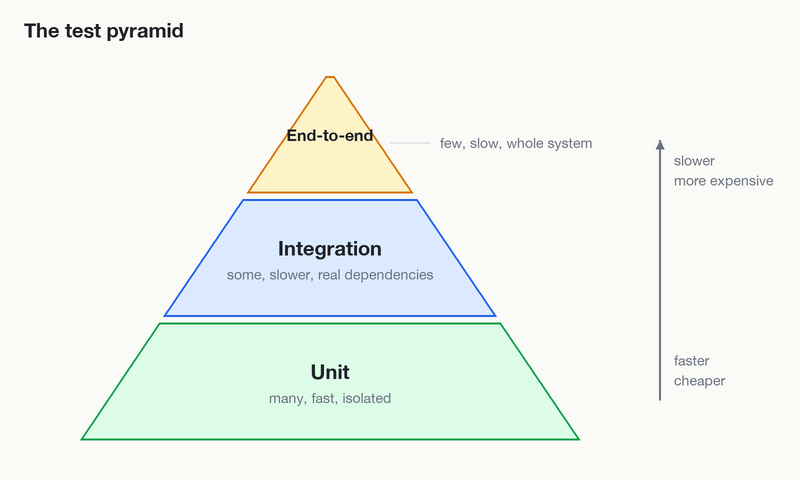
There are MANY different kinds of tests like load tests, performance tests, regression tests, and there are also property-based tests, but what are property-based tests?
Property-based tests are basic tests that, as the name suggests, are based on a given property, but what’s a property? A property can be seen as a function f(x) -> boolean, so given an input it outputs true or false. For example, imagine that we’re creating a sorting algorithm and we want to validate its implementation with tests. A sorting algorithm has many properties (conditions) that it must meet, but we can list at least two: for ALL consecutive x,y in the sorted list, x <= y, and the other property is that len(sorted(list)) == len(list).
How it works
Property-based testing has 3 main concepts, a generator, a property and a runner. A property is a function that must ALWAYS return true for any input to the code under test. A generator is the code responsible for generating, given a definition, an arbitrary number of inputs (usually 100, but it’s configurable). The runner, as its name suggests, is responsible for validating the generated inputs against the properties defined until one fails - it does more than that, as it then tries to shrink it to the smallest example that breaks the property.
![The generator creates lists, the property checks them, and after a failure the runner shrinks the input down to [0, 0]](/images/property-based-testing/how-it-works.gif)
Why use it
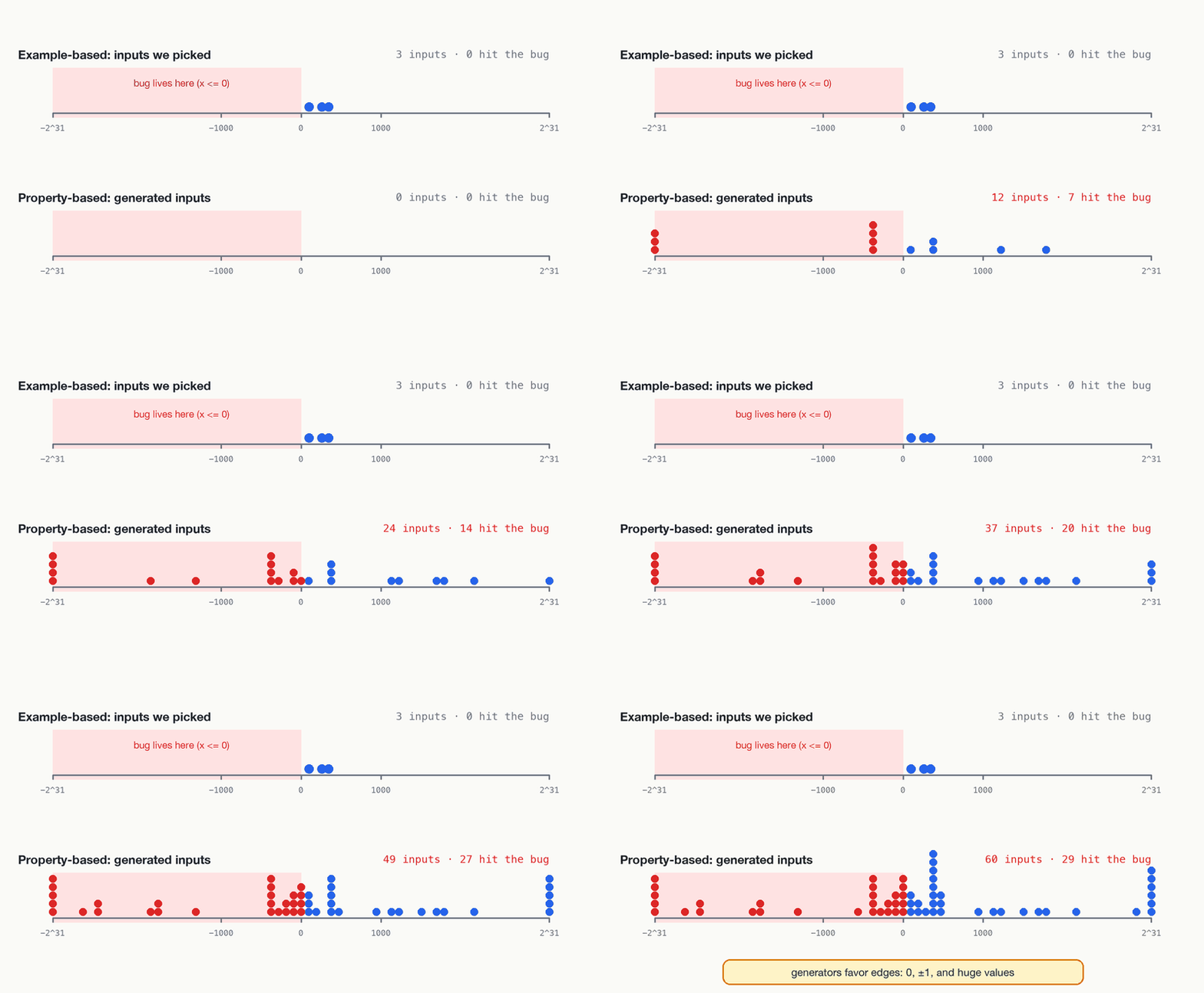
The main reason for using it is the way of thinking about tests. Usually we think about arbitrary test inputs for the function, and this has bias. When we start to think about properties we shift our way of thought to try to extract properties inherent to the code that we’re trying to test. So we shift from thinking about which tests to write to writing code that generates tests from probability distributions. More inputs get tested, which makes it more likely to find edge cases before they reach the end users.
Finding properties
The properties can be as custom as you want them to be, but there are some common patterns already, and we can highlight 4:
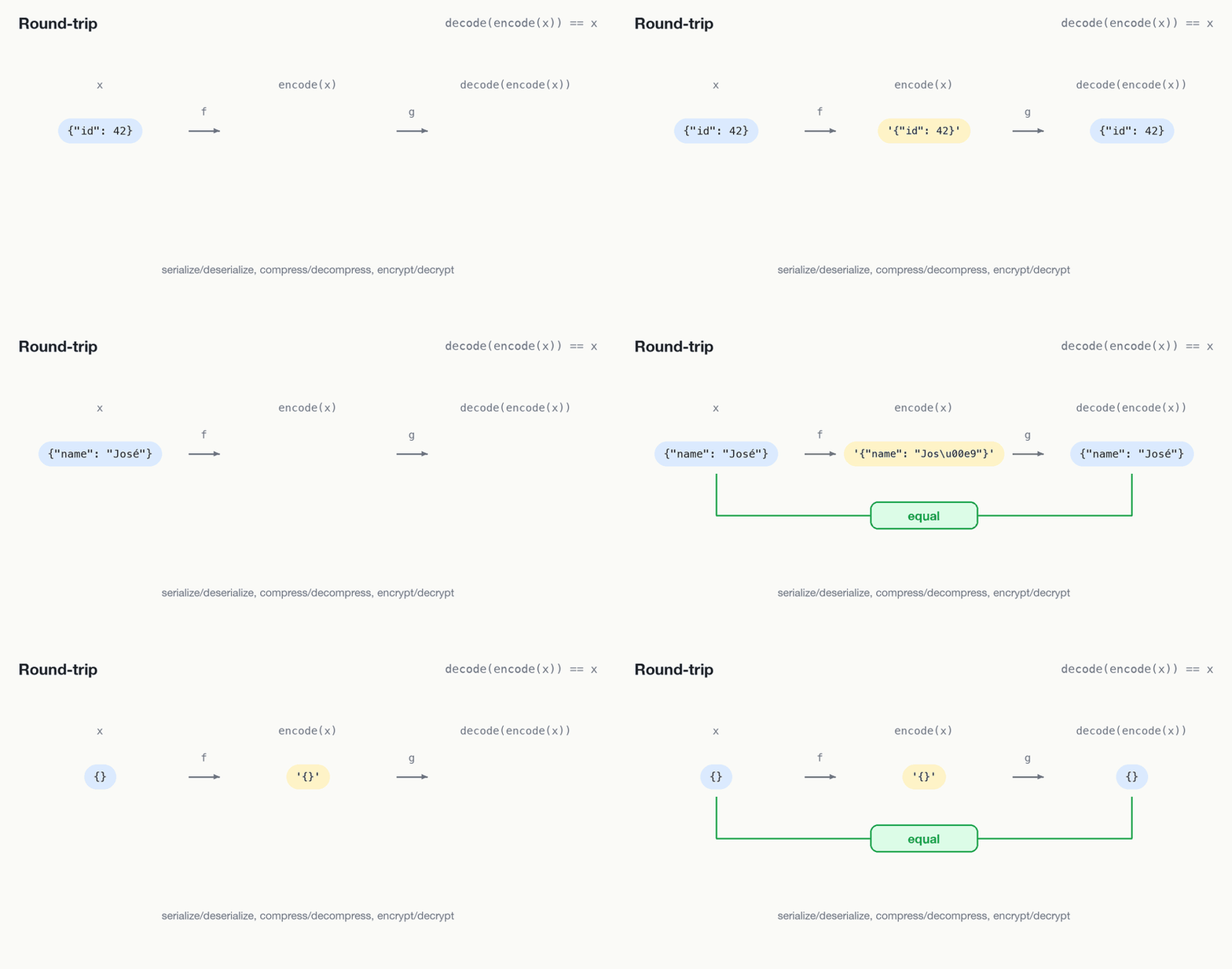
1. Round-trip
g(f(x)) == x -> common use case is serialization/deserialization
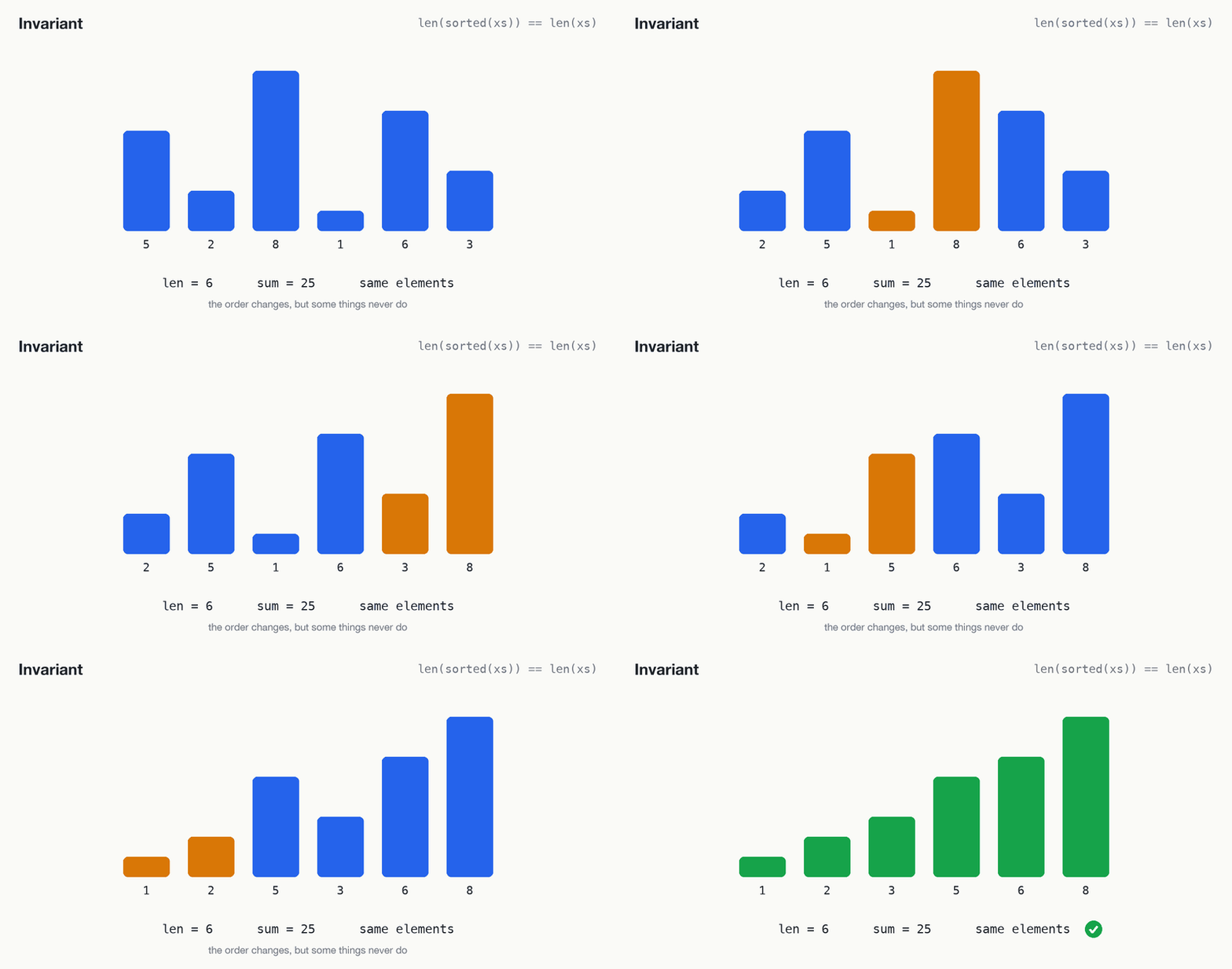
2. Invariant
Something that never changes, the len(list) == len(sorted(list)) for example
3. Idempotency
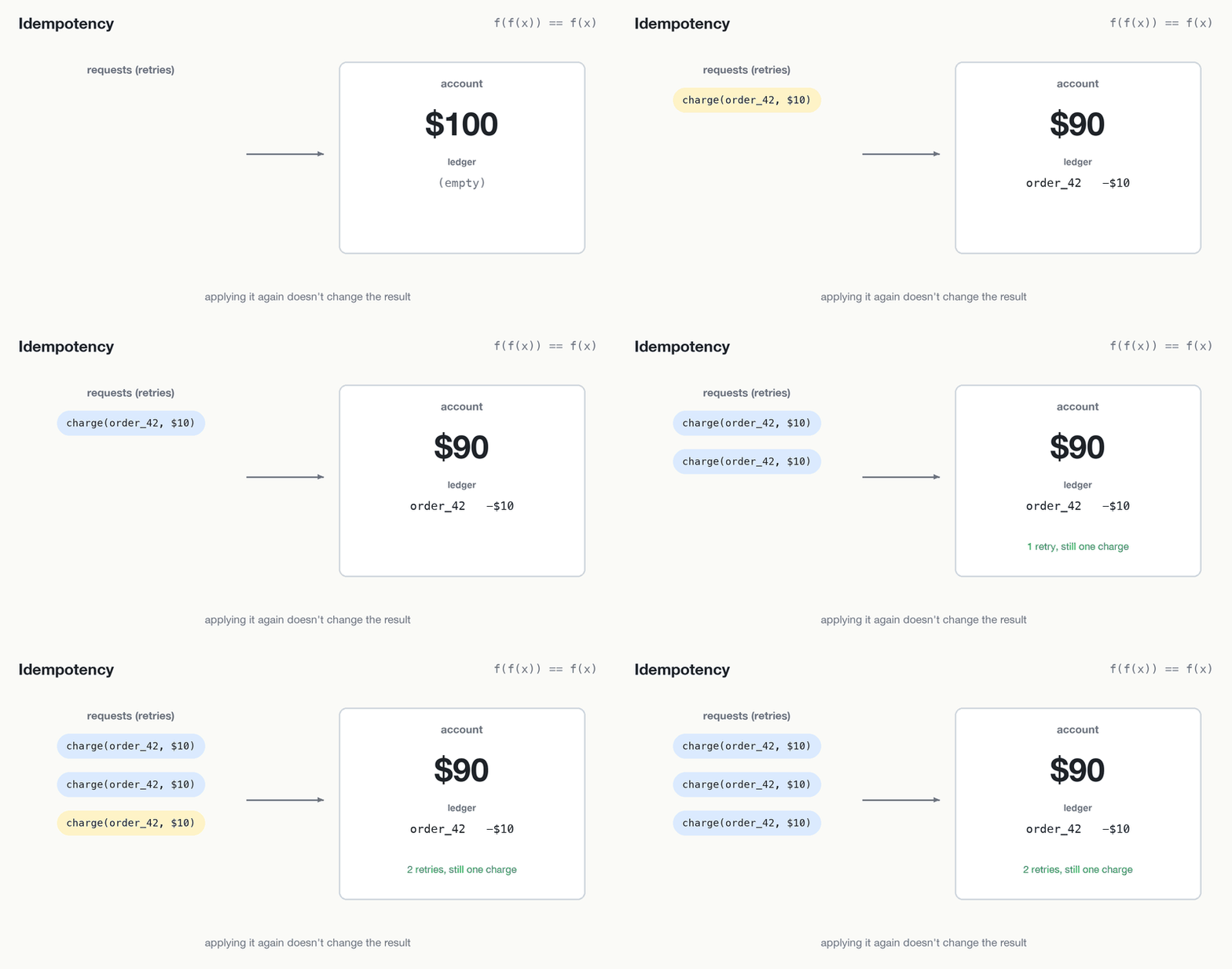
f(f(x)) == f(x). This property is essential in distributed systems and when we’re handling money operations.
4. Oracle
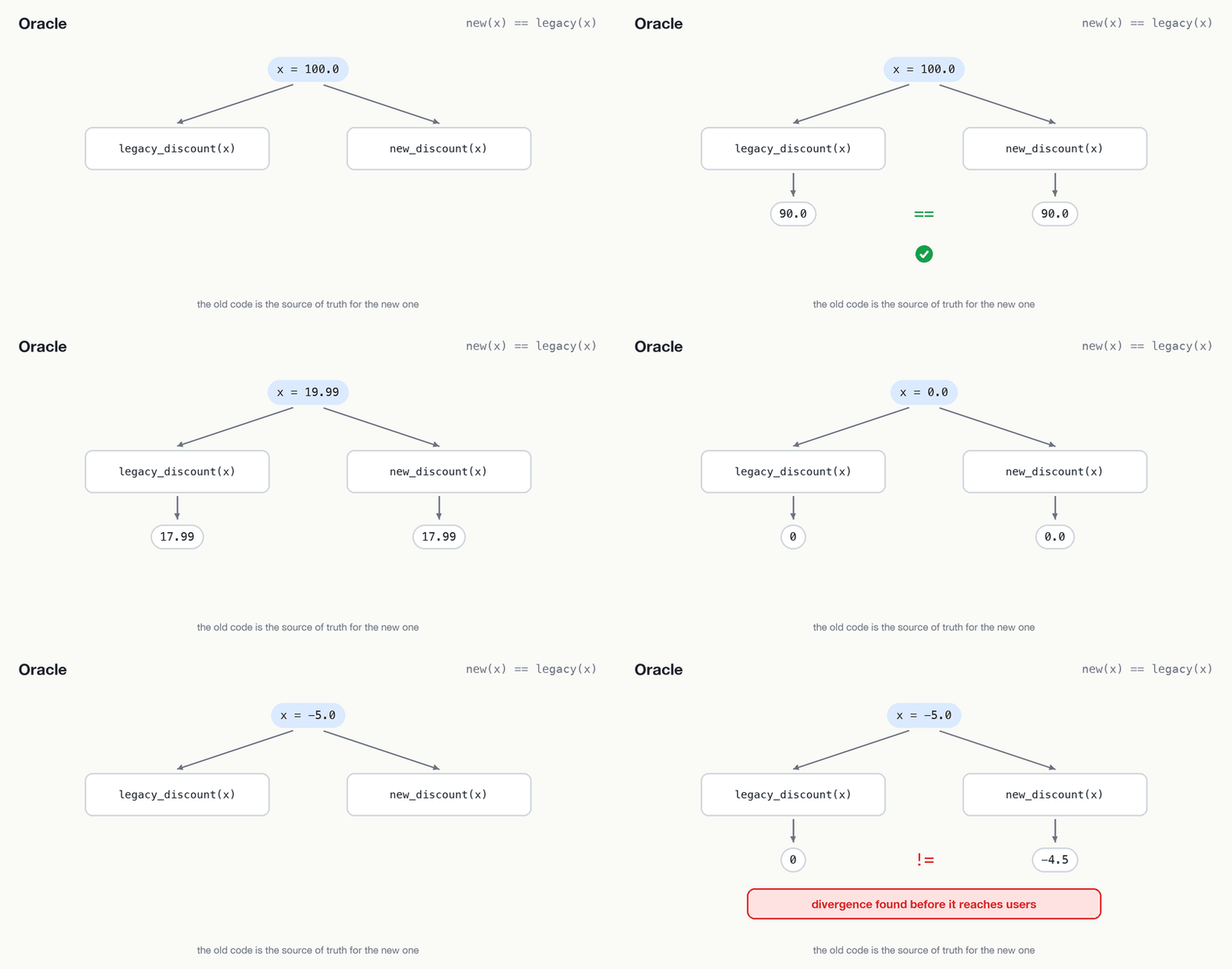
f(x) == g(x). This is very useful when we are refactoring some code or making changes. The same idea powers migrations in shadow mode.
Examples with Hypothesis
In Python, the most used library for property-based testing is Hypothesis. It plays the generator and the runner roles, so we only need to describe the inputs with strategies and write the property as a regular test. It works with pytest out of the box:
pip install hypothesis pytestRound-trip
For serialization, we can generate any JSON-like value and check that encoding and decoding gives us the same value back. st.recursive builds nested lists and dictionaries from the basic types:
import json

from hypothesis import given
from hypothesis import strategies as st

json_values = st.recursive(
    st.none() | st.booleans() | st.integers() | st.text(),
    lambda children: st.lists(children) | st.dictionaries(st.text(), children),
)


@given(json_values)
def test_json_round_trip(value):
    assert json.loads(json.dumps(value)) == value
json_values is the generator, the assert is the property, and @given hands it to the runner.
Try adding st.floats() to the base types: Hypothesis will usually find nan, and since nan != nan, the property fails (and json.dumps writes it as NaN, which isn’t even valid JSON). That’s exactly the kind of edge case we wouldn’t pick by hand.
Invariant
Now a sorting function that has a bug: it uses a set under the hood, so it drops duplicated values.
def my_sort(xs):
    return sorted(set(xs))  # bug: drops duplicates


@given(st.lists(st.integers()))
def test_sort_keeps_length(xs):
    assert len(my_sort(xs)) == len(xs)
Running pytest fails with:
E       assert 1 == 2
E        +  where 1 = len([0])
E        +    where [0] = my_sort([0, 0])
E        +  and   2 = len([0, 0])
E       Failing test case: test_sort_keeps_length(
E           xs=[0, 0],
E       )
The first list that broke the property was probably something bigger and noisier, but Hypothesis shrank it to [0, 0], the smallest input that shows the bug: two equal values.
The length alone doesn’t prove that a function sorts, though. For that, we check that each element is less than or equal to the next one, and that the result has exactly the same elements as the input:
from collections import Counter


@given(st.lists(st.integers()))
def test_sort_is_ordered(xs):
    result = my_sort(xs)
    assert all(a <= b for a, b in zip(result, result[1:]))
    assert Counter(result) == Counter(xs)
The order check passes, but the Counter check fails on [0, 0] too, since the duplicate is gone. Once my_sort returns sorted(xs), both tests pass.
Idempotency
For a charge, retrying with the same order_id must leave the ledger in the same state as charging once:
def charge(ledger, order_id, amount):
    if order_id not in ledger:
        ledger[order_id] = amount
    return ledger


@given(st.uuids(), st.integers(min_value=1), st.integers(min_value=1, max_value=10))
def test_charge_is_idempotent(order_id, amount, retries):
    once = charge({}, order_id, amount)

    ledger = {}
    for _ in range(retries):
        ledger = charge(ledger, order_id, amount)

    assert ledger == once
Oracle
When rewriting a function, the old implementation becomes the source of truth for the new one. Here the new version looks simpler, but it forgot that the legacy one never returns a negative price:
def legacy_discount(price):
    if price <= 0:
        return 0
    return round(price * 0.9, 2)


def new_discount(price):
    return round(price * 0.9, 2)  # forgot the negative case


@given(st.floats(min_value=-1_000, max_value=1_000, allow_nan=False))
def test_new_discount_matches_legacy(price):
    assert new_discount(price) == legacy_discount(price)
E assert -0.9 == 0
E + where -0.9 = new_discount(-1.0)
E + and 0 = legacy_discount(-1.0)
E Failing test case: test_new_discount_matches_legacy(
E price=-1.0,
E )We didn’t write a single test case with a negative price, and it was found anyway.
Settings and replay
By default, Hypothesis runs 100 examples per test. We can raise it for the properties that matter the most:
from hypothesis import given, settings


@settings(max_examples=500)
@given(st.floats(min_value=-1_000, max_value=1_000, allow_nan=False))
def test_new_discount_matches_legacy(price):
    assert new_discount(price) == legacy_discount(price)
It also saves the failing examples in a local database and replays them first on the next run, so a bug it found once doesn’t disappear on the next random run.
Wrapping up
Property-based tests don’t replace the tests we already have. They add another way of looking at the same code. Instead of asking “which inputs should I test?”, we ask “what must always be true?”, and let the generator explore inputs we wouldn’t think of. To start:
- Look for round-trips: anything we encode, we should be able to decode.
- Look for invariants: what doesn’t change after the function runs.
- Look for idempotency: operations that can be retried, especially with money.
- Use the old code as an oracle when refactoring or migrating.
- Trust the shrinking: the smallest failing example usually points straight to the bug.
A good first step is picking a function that already has a few example-based tests and asking which property those examples were trying to check.